Sunday, September 27, 2015

Using Data to Tell How Many More or Less

Using data to tell how many more or fewer (less) in a category is a common core standard for my first grade students. Even though I found some practice pages in our math workbook, it wasn't enough. I really needed more. I wanted additional pages, not just for classwork, but also for homework. 

Since I needed some extra practice sheets I created a packet and also a video that I posted to YouTube. In both of these resource I use a matching and circling strategy. I like having my students do this. They match the items in each category and then circle the extra. I found that this is a good strategy for helping students understand what I mean when I was ask for how many more or how many fewer. They can see that I am really asking for the difference between the two. For some reason this concept is really hard for them. They can tell that one category has more or less than the other, but they have a difficult time with the idea of comparing the two in order to answer the question of how many more or how many fewer. 

I think that students really begin to understand this as they continue to develop their number sense, so long term it probably isn't a concern, but since my students need to have this for their unit test I wanted to give them a helping hand and additional practice.

Besides using the practice pages and the video I also used manipulative in order for students to see how the items in each category could be matched. You can see my blog on Creating Story Problems for more information on how I did this. 

Here are the  links to the resources that I have talked about in case you are interested.   

Using Data to Tell How Many More or Less in a Category - Practice pages

Using Data YouTube Video 

Creating Story Word Problems


Saturday, September 19, 2015

Creating Story Word Problems

This week as part of my math centers I had my students work on story problems using dinosaurs. I wanted my students to have some hands on experience in creating their own story problems before I asked them to solve written word problems. I knew they needed this in order to really understand what a word problem is, so I got a little creative. I put a blank sheet of paper (green cardstock) in a sheet protector. Then I set out a tub of dinosaurs and some whiteboard markers. I asked students to draw their dinosaur environment/scenery and then create a story problem to go with it.

My students loved this. Some students seemed to be enjoying themselves a little too much and were taking a little too long to draw their picture and/or to pick out their dinosaurs, but when I checked on them, they were doing these tasks with a purpose. They wanted specific things in their picture and they wanted specific dinosaurs for their story problem. They really took it seriously.

When I first introduced this activity I really only gave one example. It was very simple. Example: There were 6 dinosaurs in the grass and 3 more joined them. Now there are 9 dinosaurs. As I went around to have students tell me their story problems they were using the word "joined.". They also began trying to write out their story problem or were trying to set up their equation.  I even had one student ask if they could do a subtraction problem.

This very simple activity was really worth the time. I'm going to use it again next week, but this time I am going to have student use comparison word problems. Example: There are 8 red dinosaurs and 2 black ones. There are 6 more red than black and there are 6 fewer black than red.


Anna Navarre's TpT Store

Sunday, September 6, 2015

Barn Animal Phonics

I was going through some of my resources the other day and I pulled out this Barn Animal Phonics activity. It is a little too early in the year for me to use it with my first graders, but it is one of my favorite review activities.

Students read the animal cards and put them in the barn if they can read the words or in the pasture if they can't. The set includes CVC, ll, ck, CVCe, and vowel team words. I like using it as a review activity because of the various phonics rules. It also works well for providing differentiation for students who are already reading. This activity is a good way for students to practice words and to help strengthen their overall reading fluency. 

I like using this set as a center activity. There are five different types of animal cards. I make two sets of each. I keep each set of cards in a plastic bag. Having the extra cards at the center gives students enough choices, so they are able to keep busy without having to wait on others. I encourage students to partner up with someone (a stronger reader) if they need support with some of the harder words. 

Another way I like using this activity is a resource for struggling readers. It is a good way for students to practice and help monitor their own progress. They can see how many more words are going in the barn vs the pasture as they learn to read the words. 

You can purchase this product and my TpT Store if you are interested. Here is the link:


Saturday, September 5, 2015

Desk Decorum


At the end of the first day of school, some of my students already had messy desks. I teach first grade, so my students have never had to be responsible for keeping their desks orderly before. I'm not quite sure that some students even know what this means. In order to help make my point a little more clear, I decided to take some pictures of some examples.


I first showed my class this student's desk and talked about this being pretty good, but that the bag of counting cubes could be placed in the pencil box. 


I then showed them this picture and asked my students what they thought about this one. They agreed that it was pretty organized. 

Next, I showed this picture. We again discussed what students thought about this desk and how it could be more organized. 

Lastly, I showed this picture in which we again discussed how this student's desk could be more organized. 

I didn't mention any names as I showed the pictures, and it wasn't done to make anyone feel bad, it was just a good way to help students realize what is being expected of them. One problem with the two unorganized desks would seem to be the lack of a
pencil box, everyone has one now, but that doesn't mean that things always get put back in the boxes, so the pictures are still helpful.

After showing students the pictures I gave them a couple minutes to make sure that their desk decorum was up to par, or basically that things weren't falling out of their desks. Then I introduced the idea of the Desk Fairy. I let them know that the Desk Fairy would be checking to make sure that they were keeping their desks organized. If the desks were not nice and neat then the Desk Fairy would be leaving a card on their desk as a reminder. 

This was just one of those Back to School lessons that needs to be done, but it was actually very helpful. I'v included the link to my Desk Fairy Freebie Cards if you are interested. I have found them to be a useful tool. 


FREEBIE! Desk Fairy - Clean Your Desk Notice

Anna Navarre's Teacher Pay Teachers Store


Sunday, August 30, 2015

Number Talks

Over the last few years, number talks, also known as math talks, have become an important part of our math program within my district. The emphasis has been placed on students being able to "think" about math and be able to explain this thinking. For first grade, I can say that in a way, number talks have always been the emphasis. You need to talk through everything to help these young learners begin to develop number sense. The difference between what I have done in the past and what I do today, is that before I was doing most of the talking and explaining. Now, students are doing more of that.

Number talks encourage all students to be active as a problem is presented. All students should be thinking about the problem and trying to mentally solve it. As students come up with the solution they indicate that they are ready by showing a thumbs up, which is held in front of their chest. After students have had some time to solve the problem students share how they came up with the solution. The teacher (or student) records the process on the board, clarifying as necessary, so that everyone can see how the problem was solved and the strategy that was used. The teacher continues to have other students share the different ways that they solved the problem. This allows students to see that there is more than one way to solve the problem. It gives them a better sense of how the numbers can be manipulated. Number talks are not meant to be a long lesson. They are short 8-10 minute talks that are intended to help students learn to manipulate numbers, learn more strategies, and build their overall fluency.

As I was visiting a website that was sent out by my district I came across a Number Talks Youtube video by Jo Boaler. It is a good video to help both teachers and parents understand how number talks work, not just how they are done, but the overall benefit and importance of the process and the effect.

Here is the link if you would like to check it out: 

Feel free to visit my TpT Store. You can also follow my store to get notifications of free and paid newly posted products.  


Tuesday, August 25, 2015

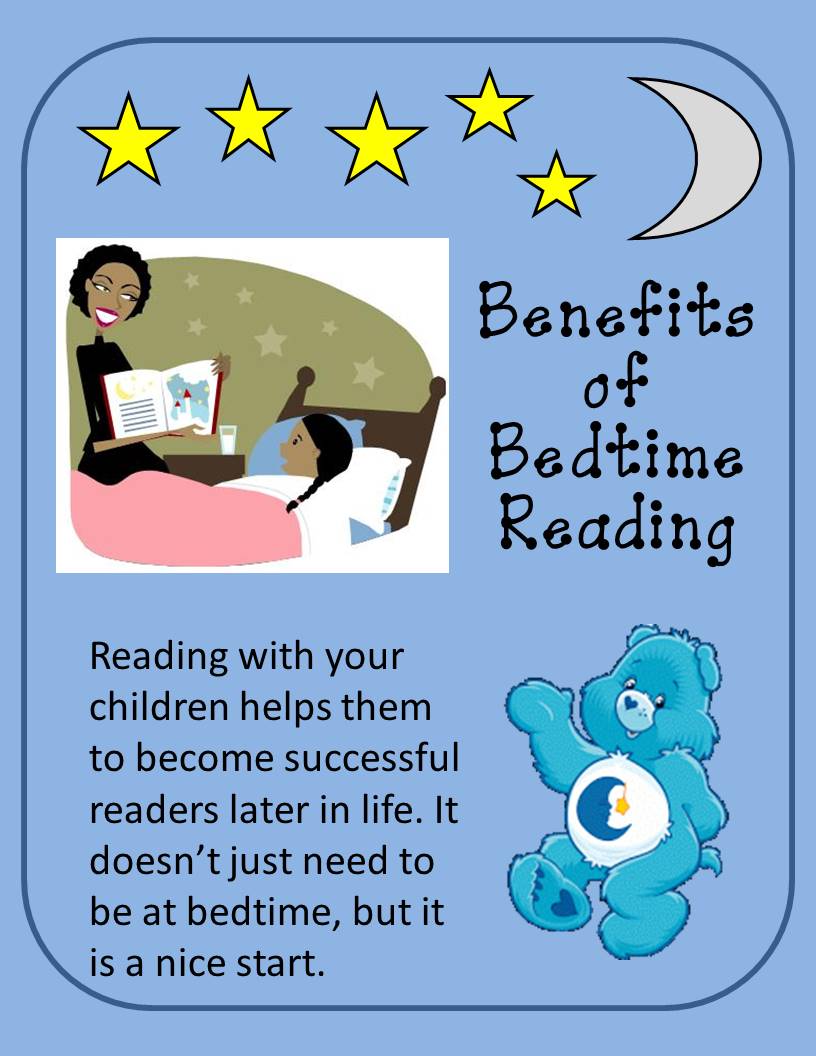
Benefits of Bedtime Reading

I just read an article, Bedtime Stories for Young Brains, by Perri Klass, M.D. There were some things that really stuck out to me, even though I was aware of the benefits of bedtime stories, this perspective made me stop and think about it a little more.

Yes, so we all know that spending time with our children and reading to them is a nice and lovely thing to do. It is a special time to enjoy with our children and to show them how much we love them. We also know that it is a good way for children to see patterns and learn sight words, but there is more to it than that. When kids hear a story they are able to mentally picture these images through their “mind’s eye.” The practice of developing these visual images will help them later to become better readers and to develop the comprehension that goes with it.

I have a book of fairy tales in my classroom. It is a book that my husband gave me when I first started teaching. Every class that I have ever had has loved when I read from this book. It doesn’t have many pictures, and I don’t show the pictures until after I have read the page. My students always try to sneak a peek, but I encourage them to use their imagination first. This book is a great way for students to begin using their visual imagination.

Besides spending precious time with our children at bedtime, and helping them strengthen their visual imagery, there is an additional benefit to reading with our children. This is the benefit of building vocabulary. As a teacher I definitely have seen the benefits of this. The books that we read in class provide students with exposure to words that don’t normally come up in everyday conversation… that is until we have read/heard it from a book and discussed it. Students initially overuse the words and not always in the correct context, but eventually many of these words become part of their verbal/written vocabulary.

When my children were young they often had other kids comment on their vocabulary. It was hard for my husband and I to understand why this was, it was just the way we spoke. Now that I have grand kids, I’m able to see it much more clearly. My grand kids use vocabulary that sometimes surprises me, and they use it naturally. Since a very young age, my granddaughter has used the word, “adorable,” to comment on cute puppies and babies. It isn’t that we spend time drilling our grand kids on vocabulary; it is just what they have been exposed to through books, conversations, and experiences.

With the school year beginning and many of my first graders not yet being readers, I definitely want to remind my families of the importance of spending time reading together. There are just so many benefits to it. 

If you are interested in reading the article, Bedtime Stories for Young Brains,you can click on the link.   Bedtime Stories Link 


Anna Navarre's TpT Store 


Wednesday, August 5, 2015

Teaching Inference

Teaching inferencing to young readers can be difficult, yet as students are being asked to read at higher levels, the teaching of inferencing becomes greater. Students need to have inferencing in order to help with the comprehension of  these higher level books.

The major obstacle with inferencing is that young readers just don’t have enough life experience (background knowledge). In order to help them with this we need to help them learn how to use clues from the text along with what they know about a situation to help them understand how to pick up on inferences.  

As young readers are reading books or as we read to them, it is common for us to focus on the retelling of a story and making prediction. Very little time, if any, is spent on making inferences. You may even be unclear about what the differences are between predictions and inferences. Maybe this will help to clear it up.  

Inferences and Predictions: In both inferences and predictions you use the text to support your ideas. You also use your background knowledge (life experiences) to help support these ideas.

Prediction: A prediction is a guess about what we think will happen in the future. It is almost always confirmed.

Inference: An inference is made about things that have happened in the past or at the current time. Inferences are rarely confirmed, but they are logical based on what we have learned (text) and what we know (background knowledge). 


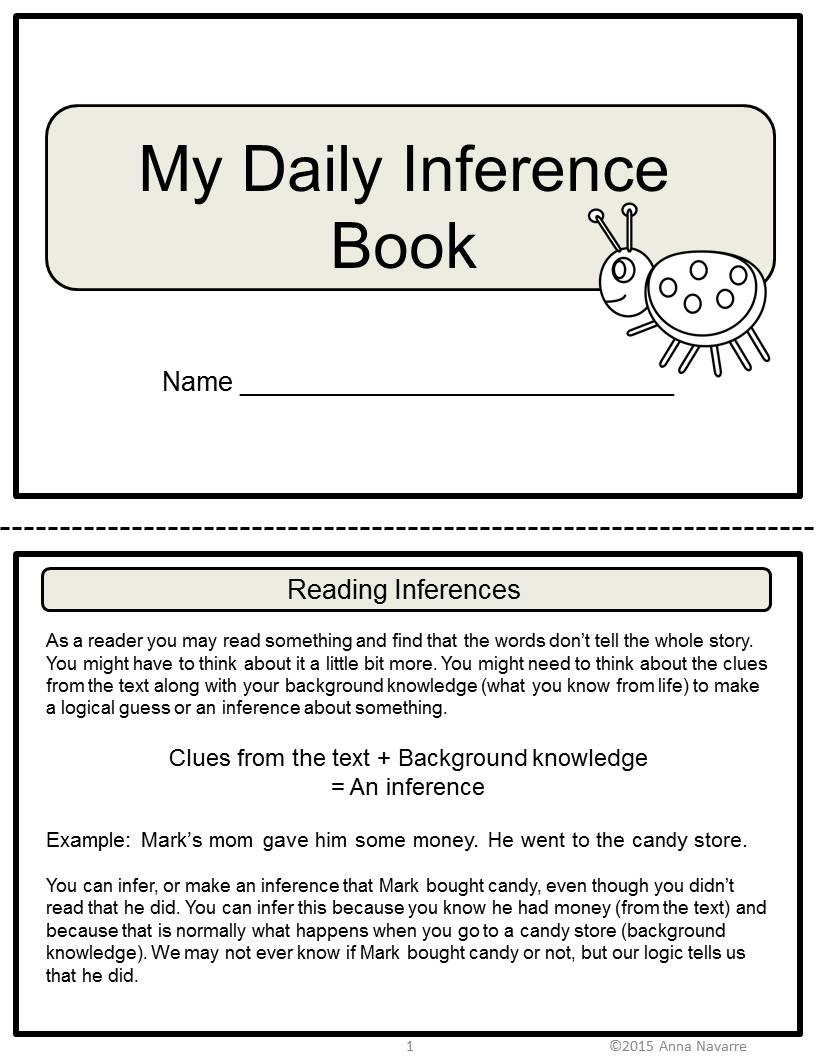
It really doesn’t take a lot of explaining, but it does take practice to really begin to understand what an inference is. The first step is to be conscious of the need for it. As you read with your students either whole class or in a group, be sure to take the time for students to make inferences. I like to support my students in this way, but I also like to have something that holds them a little more accountable than just a partner share. This was one of my main reasons for created a Daily Inference booklet. It is a resource that I have made available at my TpT Store if you are interested in checking it out.


Daily Inference Book